
Dirty List has the usual suspects and some surprises too – Rashmee
The Burma Campaign UK, published its “Dirty List of international companies linked to the military in Burma, or companies whose operations are linked to human rights violations or environmental destruction”, reports the journalist Rashmee Roshan Lall.
The 49-strong list included America’s Western Union and Facebook, India’s Tata, and Japan’s Toshiba. Burma Campaign UK said its aim was to put pressure on “companies to stop doing business with the military … To date, the main response of the international community to genocide in Burma has been to impose a ban on a small number of military personnel going on holiday to certain countries.”
NGOs hit back at profiteering charge – Myanmar Times
Humanitarian organisations have hit back at accusations that they are blocking the repatriation of Rohingya refugees living in crowded camps in Bangladesh.
Mark Farmaner, director of Burma Campaign UK, described as nonsense the Burmese government’s accusation that NGOs are trying to prevent refugees from returning to Myanmar because they are making money. He said refugees are refusing to return because neither the government nor the military respect their human rights: “The government only wants refugees to return as a public relations move to try to avoid more international pressure.”
TWO and BCUK at film festival on sexual violence in conflict
Lway Poe Kamaekhour from the Ta’ang Women’s Organization (TWO) joins Zoya Phan and Anna Roberts from Burma Campaign UK at the 2018 Film festival on Preventing Sexual Violence in Conflict, at the BFI London.

From peace icon to pariah: Aung San Suu Kyi – the Guardian
“There are falls from grace, and then there is Aung San Suu Kyi”, says the Guardian’s Southeast Asia correspondent in an examination of how the Nobel peace prize winner has become a global pariah at the head of a regime that has excused a genocide, jailed journalists and locked up critics.
Mark Farmaner, Burma Campaign UK’s Director, told the Guardian: “We knew the 2015 election was not a transition to democracy, we knew the military’s intent was not genuine, but we thought that at least Aung San Suu Kyi would move in the areas she could with a parliamentary majority: things like releasing political prisoners, repealing repressive laws, creating a free press, trying to improve the economy, environmental issues. She hasn’t done any of those things. Even the limited expectations we had have not been met.”
What next for the Rohingya? – the Guardian
As Rohingya refugees in Bangladesh refuse to return to dangerous and volatile conditions in Rakhine State, Burma Campaign UK’s director Mark Farmaner called Burma’s pledge to bring back 150 Rohingya a day a charade. He told the Guardian it would mean repatriation of the million refugees in the camps would take almost twenty years.
“Myanmar has no intention of taking them all back or reinstating their citizenship. You can clearly see that they’ve only built camps to house around 30,000 Rohingya, the amount of refugees they consider to be a small price to pay to take back to get the international community off their back – but they certainly don’t want any more than that.”
Justice4Rohingya meet Afzal Khan MP
Our Director Mark Farmaner in his capacity as Director of Justice4Rohingya, in a meeting with Afzal Khan MP, Labour MP for Manchester Gorton and Shadow Home Office Minister for Immigration.

Northern Burma speakers at UK Parliament
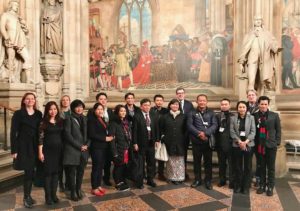
BCUK team with Northern Burma delegation Kachin, Ta’ang and Shan, and Christian Solidarity Worldwide in the UK Parliament where the delegates spoke at the All Party Parliamentary Group on Burma.
Rohingya Citizenship: Now or Never? – Mark Farmaner in LSE blog
With Burma’s general election exactly two years away, the next 12 months may be the last chance to reform the law, give the Rohingya their long overdue citizenship rights, and help create conditions for the safe return of a million Rohingya refugees in Bangladesh.
Mark Farmaner, director of Burma Campaign UK, writes in the London School of Economics’ South Asia blog: “The single most important step the government of Myanmar can take is to reform or replace the 1982 Citizenship Law and give citizenship to all Rohingya.”
Displaced Karen villagers oppose UK charity over land conservation – the Guardian
Karen people who live in Burma’s south-eastern Tanintharyi region are opposing a ridge to reef project planned by British conservation charity Fauna and Flora International and the UN’s development programme. The project aims to protect pristine forest in the area from threats like poachers, loggers and palm oil companies.
The Conservation Alliance of Tanawtharyi (Cat), a coalition of local environmental groups, says the project will displace Karen villagers from their ancestral lands, which they conserve using indigenous practices, and upset the 2012 ceasefire agreement between the rebel Karen National Union (KNU) and the Myanmar military.
Zoya Phan interviewed by University of East Anglia
Zoya Phan, Burma Campaign UK’s Campaigns Manager, graduated from the University of East Anglia in 2005 with a MA in Politics and Development. Asked by UEA’s alumni team for her advice to students, Zoya said “Use your university education to strive for a better world, take risks, make decisions and go out there to make a difference.”