Blue Shirt Day: A Movement of Global Solidarity with Political Prisoners in Burma (Myanmar)
By Minn Tent Bo, Advocacy and Communications Officer
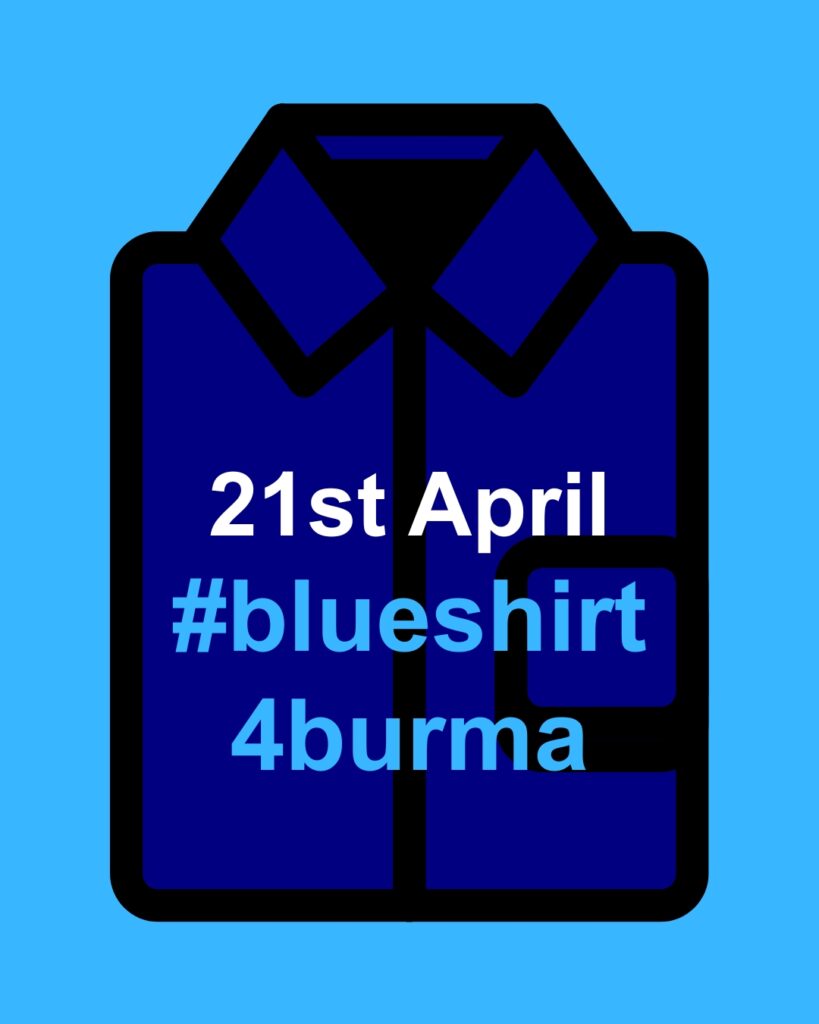
Blue Shirt Day is an annual occasion that takes place on 21 April. It is not simply about people wearing a blue shirt; it is about standing against the ongoing practice of imprisoning, torturing, and disappearing political prisoners and the systematic effort to forget them. It is about refusing to give the Burmese military a propaganda boost to present its political prisons and torture facilities as places of reform and to portray sham elections as a new step for democracy. The purpose is to draw more international attention to political prisoners in the prison system and to demand the unconditional release of all political prisoners.
Blue Shirt Day has its origins in the spirit of a democratic struggle. U Win Tin, a Burmese veteran democratic journalist, was sentenced to 69 years’ imprisonment by the Burmese military. However, the United Nations and other civil and human rights organisations around the world had recognised U Win Tin’s imprisonment to be an act of gross violation of human rights and were pressing for his release. He is a key figure in the struggle for democracy. He wrote of his time in prison: “A human being can fall from the bottom of the world to hell.” He was one of the most important and influential figures in the democratic struggle of modern Burma. After he was released from prison, he continued to wear his prison uniform, a blue shirt and longyi to make a statement, campaigning for the release of all political prisoners until his death.
U Win Tin died on 21 April 2014. Soon after that, the Burmese people and the Burmese democracy movement began to wear blue shirts on 21 April every year, it was the same reason as he kept wearing the blue shirt, to raise awareness of political prisoners still in jail. This day has become Blue Shirt Day. This movement has continued the spirit to stand in solidarity with political prisoners. The movement is based on the demand that all political prisoners should be freed, and all political prisoners’ conditions be made known to the world.
The Burmese military has arrested more than 30,000 political prisoners and tortured many of them since the coup in February 2021. The Burmese military has used the state security apparatus and the judicial system to try political prisoners for crimes of treason, sedition, terrorism and the like. According to the Assistance Association for Political Prisoners (AAPP), at least 14,000 political prisoners are still behind bars in the country. The military has arrested hundreds of people for political reasons and has tortured hundreds more in the prisons and detention centres.
The Burmese military has used its new and existing laws and laws from previous regimes, such as the Counter-Terrorism Law of 2017 and the Penal Code provisions on “sedition and conspiracy to overthrow the government”, such as Section 505A of the Criminal Law and other provisions of the Criminal Law. The laws have been used to make the ordinary act of protesting against the government a crime of terrorism. These laws mean that acts such as peaceful demonstrations, criticism of the military, association with resistance groups, or simply having family members who are alleged to be part of the opposition can be charged as offences of terrorism. Human rights organisations and Burmese activists have highlighted how the broad scope of this definition is crucial to the regime’s ability to imprison thousands, yet maintain the pretence, when speaking internationally, that they are detained for the reason that they are a “security threat”.
Prisons and detention centres are often brutal, especially for political prisoners. Torture, in the form of beatings, pain-inducing positions, rape and sexual violence, is used, with the systematic use of violence often reported by former detainees and human rights monitoring organisations. Political prisoners have no access to adequate food and medicine and are denied medical treatment; and female prisoners suffer gender-specific abuses in relation to women’s reproductive health. This suffering is intended to punish and control prisoners and to dissuade others from resisting. Blue Shirt Day is an opportunity to highlight the extent of the conditions within the prison and to state that no so-called “reform” can be taken seriously as long as such abuse continues.
In this context, the Burmese military’s very public amnesties can be characterised as political propaganda, rather than reform. Following elections in late 2025 and early 2026 which were not free and fair, the military announced it was releasing some political prisoners. Recently, another 4,335 people were released from prison, including death sentences commuted to life sentences, a move the military described as an “act of mercy”. No details on the released individuals were given, including their names, whether most were political prisoners or not or whether there were any conditions attached to their releases such as being re-imprisoned if they “reoffended”.
These amnesties form part of the wider efforts by the Burmese military to portray itself as a civilian regime. It is the military which is cynically using political prisoners as a propaganda tool. By releasing a few thousand, or a well-known political prisoner, the Burmese military hopes to gain some positive press coverage, deflect international criticism and to prompt foreign governments to take a more diplomatic approach, including re-opening lines of communication with the military regime to restore economic and diplomatic relations. This strategy is not new. A wave of “lesser known” prisoners will be released at once to be followed later by some high profile individuals being freed, as the regime did to generate headlines for its “openness” when it announced in April 2026 that President Win Myint and prominent journalist Shin Daewe had been released, while at the same time the military regime began circulating press rumours that the sentence against Aung San Suu Kyi would be reduced. The aim is to attract applause from the international community, all the while keeping the repressive state mechanisms intact.
At the same time as these amnesties are announced, some political prisoners who are released are arrested again soon after or even days later for committing new alleged crimes. And there is no prospect of the repressive legal framework that is used to imprison these thousands of people being dismantled. If the regime were truly committed to political reform, it would not hesitate to release all of its political prisoners, abolish repressive and draconian laws and completely stop arresting political prisoners. The regime has done none of these things, and for thousands of people including Aung San Suu Kyi, and the young activist Wai Moe Naing who received a sentence of 74 years for organising the pro-democracy protests, the prison is likely to continue.
Thus, Blue Shirt Day has multiple purposes. One is to challenge the military’s framing. Blue Shirt Day is about a personal act of solidarity by U Win Tin and thus underscores the reality of individuals with names, stories, and families. “Tell friends and colleagues why you are wearing blue” encourages the telling of individual tales from Aung San Suu Kyi and Win Myint to lesser known, but equally worthy activists. Another purpose is to continue the pressure for change. Sustained international pressure has historically contributed to prisoner releases, reduced abuses, and the shaping of Burma-related policy. Although the Burmese military may be adept at manipulating global opinion, its interest in that opinion is one reason why it uses public relations campaigns like the amnesties. A concerted Blue Shirt Day campaign would remind governments, international institutions, companies and other non-state actors that engagement with the regime cannot be separated from its use of torture and arbitrary detention.
Furthermore, this is not only important for the moral reasons of solidarity but has the potential to underpin other means of pressure such as sanctions or the isolation of the Burmese military and support for civil society in Burma. Blue Shirt Day helps to bring attention and support to these activities at a time when people’s attention and energy need to be constantly channelled. On 21 April 2026, 12 years after U Win Tin died, Blue Shirt Day is still necessary. The Burmese military’s amnesties are nothing more than window dressing and its efforts to mask its continued rule as a civilian presidency are nothing more than a PR campaign using the laws on arbitrary detention and repression to do so. There is an unresolved question of power, of accountability and of the basic rights of people to be free of oppression. People are still being detained as pawns for such political manipulation. Blue Shirt Day is not the solution but a modest reminder that these people cannot be forgotten and used as pawns and that, unless they are released, the blue shirts have yet to achieve their purpose.
This article was originally published in Mizzima on 21 April 2026.